
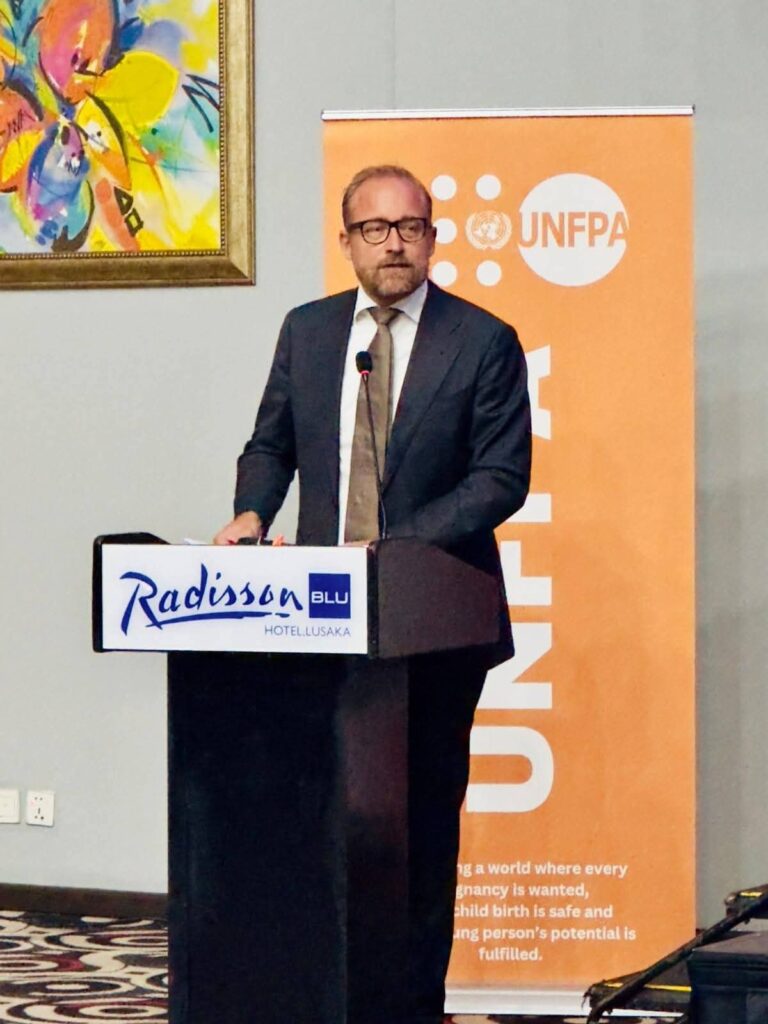
The United Nations Population Fund (UNFPA) says it remains committed to supporting Zambia in reaching a point where there is zero unmet need for family planning and zero maternal deaths.
Speaking during a stakeholder engagement, UNFPA Country Representative Seth Broekman said the focus of the meeting was to ensure that all essential medicines and commodities reach end users within the supply chain process.
Mr. Broekman noted the need to address barriers in the supply chain that hinder the delivery of medicines to intended beneficiaries. He added that distribution points should not be limited to health facilities, but extended to places where young people, women, and men can easily access sexual and reproductive health and rights (SRHR) services.
“We have noticed a continued rise in HIV cases, unwanted pregnancies, and sexually transmitted infections. So, it’s not just contraceptives that must be readily accessible but condoms too,” he said.
He explained that UNFPA has been identifying alternative access points, including hospitality establishments such as bars, lodges, and restaurants, where people may prefer to obtain these products and services.
Mr. Broekman also expressed satisfaction with the Zambian government’s growing commitment to domestic funding for SRHR products and services. He said government has significantly closed the gap in funding for family planning commodities, particularly through the recently signed health compact.
“The Zambian government has really stepped up in domestic financing, especially for family planning,” he said.
He disclosed that under the compact agreement between UNFPA and the government, Zambia has increased its annual investment in family planning commodities from $2.7 million in 2023 to $4 million, then $4.3 million last year, with projections of about $6.5 million next year.
“So you can see that the government of Zambia is really taking responsibility, and because of that, we also have a match fund of up to $2 million,” Mr. Broekman added.


